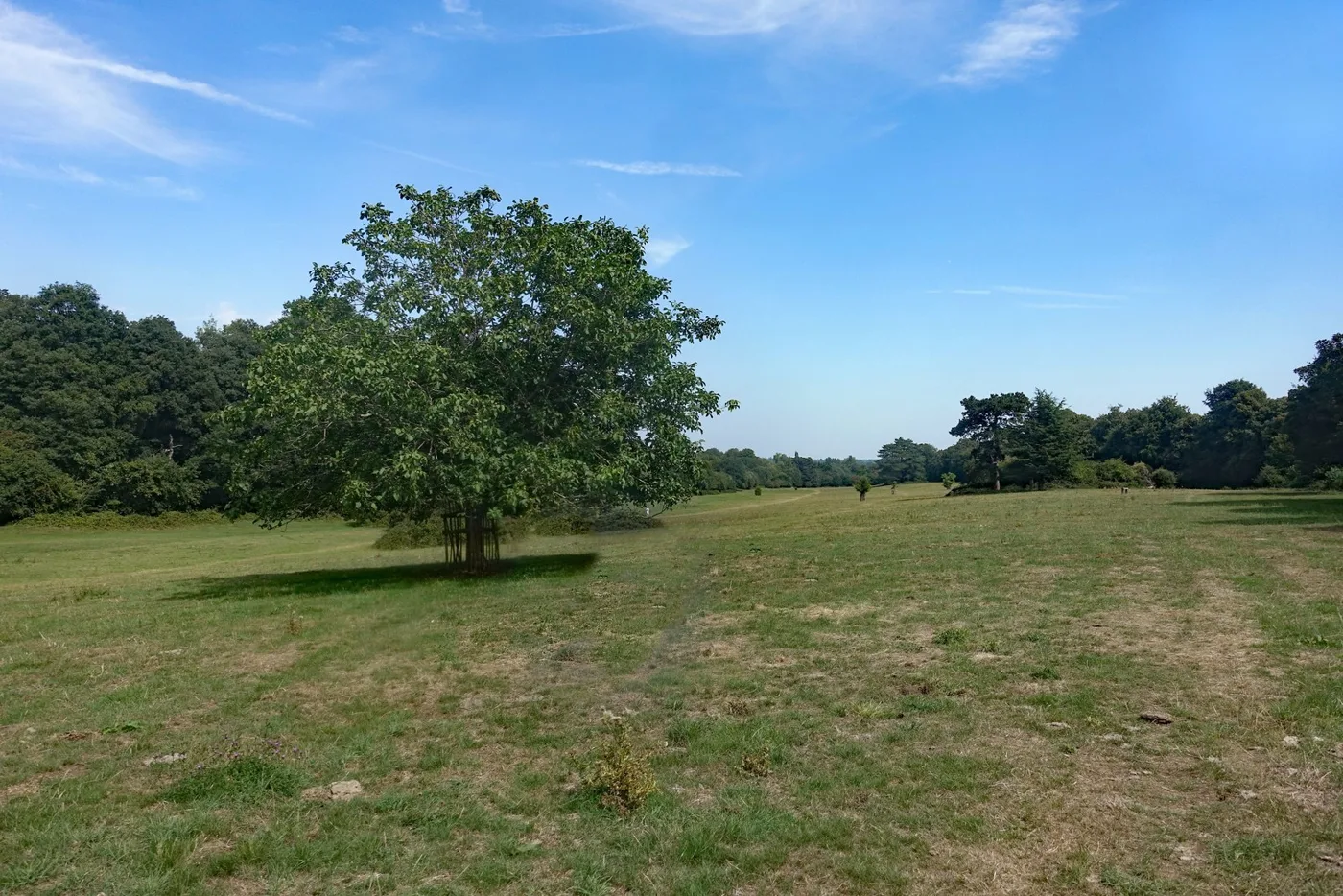

Waverley decides on 1 September whether to spend £2,055,712 on 20.87 acres beside Farnham Park. The park's capacity for new housing is down to 16 homes.
Waverley Borough Council will decide on 1 September whether to spend £2,055,712 buying two fields off Hale Road, next to Farnham Park. The land totals 20.87 acres, or 8.45 hectares. (Executive agenda, 1 September 2026)
The purchase is not about parkland for its own sake. It is about planning permission. Farnham Park is the only site in the borough that lets new housing in Farnham get consent at all, and it is effectively full.
Sixteen homes of capacity left
Most of built-up Farnham sits inside a five kilometre buffer around the Thames Basin Heaths Special Protection Area, a protected heathland for breeding Dartford warblers, nightjars and woodlarks. Building homes inside that buffer adds people, and more people means more recreational pressure on the heath.
Developers get round this by paying for Suitable Alternative Natural Greenspace, known as SANG: somewhere else pleasant to walk the dog. Waverley’s only SANG is Farnham Park, and its capacity is measured in dwellings.
The council’s own figures, dated 1 January 2026, show how little is left:
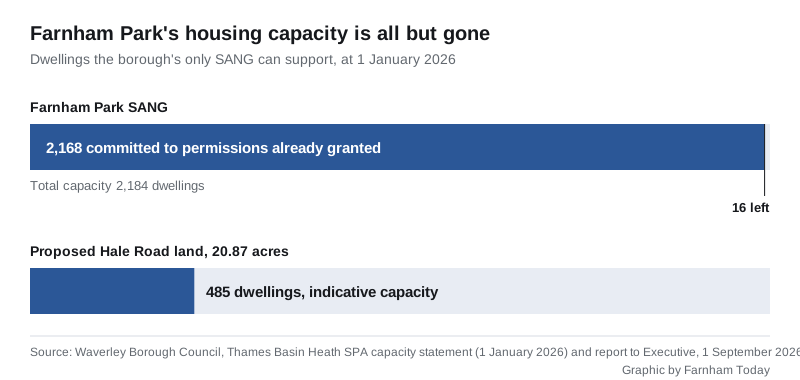
- 2,184 dwellings of total capacity
- 2,168 dwellings already committed to permissions granted
- 16 dwellings of unallocated capacity remaining
- 2 more dwellings would come off that if an appeal is allowed
(Waverley Borough Council, Thames Basin Heath SPA)
The consequence is written into the same page. “In the event of there being insufficient capacity to support proposals for residential development, and unless applicants can provide or secure alternative SANG in accordance with the Avoidance Strategy, permission will be refused.”
Officers put it more bluntly in the report going to the Executive. Capacity “has now been committed for developments within the area”, and “developers are now relying on privately owned SANGs and SANG owned by Guildford Borough Council”. (Acquisition of land off Hale Road, report to Executive and Council)
What the council would be buying
The two parcels are registered under three title numbers. One parcel of 13.25 acres is title SY822163. The other, of 7.62 acres, is titles SY822165 and SY814044.
The site plan published with the agenda shows them running north from Hale Road and Lower Road, taking in ground beside Farnham Park Cemetery and next to St John’s Church. (Appendix 1, site plan)
The maintenance schedule drawn up for the site divides it into three meadows and sets out what would be put on it. That list includes an orchard of 140 trees, new native hedging, five parkland trees of pine, beech and oak, pond management, seating, bins, dog bag holders, fencing and gates, and signage. A playground and a car park are both listed, with the car park marked “not known” and footpaths dependent on how waterlogged the ground turns out to be. (Appendix 5, initial cost and 10 year maintenance)
The report also mentions “some additional car parking capacity for both the neighbouring St John’s Church and the popular Farnham Park”.
The bill, and who pays it in the end
The heads of terms and the RICS valuation are exempt from publication as commercially sensitive. The financial appraisal is not, and it sets out the numbers. (Appendix 4, financial appraisal)
- £1,683,500 to buy the land, including stamp duty
- £372,212 of capital costs to set it up as SANG
- £2,055,712 total, the supplementary estimate councillors are asked to approve
That comes out of three pots: £900,000 from the SANG reserve, £373,000 from capital receipts and £782,712 from general fund working balances.
The council expects to get it back from developers. Contributions are secured through section 106 agreements, and on an indicative capacity of about 485 dwellings the report estimates total SANG income of around £1.6m, modelled prudently as £160,000 a year for ten years. Running the site is costed at £23,000 to £33,000 a year, rising over time. On those assumptions the outlay is paid back at about year 16.
Those are assumptions, and the report says so. Income only arrives when permissions are granted and homes are actually built.
What developers currently pay
Waverley’s published calculator, for applications from 1 April 2026, charges SANG at £1,520.05 per person and the separate Natural England monitoring tariff, SAMM, at £518.11 per person. Occupancy is assumed by bedroom count, so the charge per home is fixed:
| Home | SANG | SAMM |
|---|---|---|
| 1 bed | £1,991.27 | £678.72 |
| 2 bed | £2,675.29 | £911.87 |
| 3 bed | £3,815.33 | £1,300.46 |
| 4 bed | £4,347.34 | £1,481.79 |
| 5+ bed | £5,669.79 | £1,932.55 |
A monitoring fee of 5% is added on top of the SANG element, and legal costs are charged on application. (SANG contribution calculator)
The catches
Officers list several. The land carries restrictive covenants, and Southern Electric Power Distribution has an easement for overhead power lines, with rights to cut back trees and restrictions on planting near the lines. Separate historic covenants protect a view across the land.
The council also needs planning permission to change the use of the land to SANG, and the report states the acquisition “will only proceed if planning permission is granted”.
Then there is the reorganisation. Waverley is abolished on 1 April 2027 and replaced by West Surrey Council. Under a direction issued by the Secretary of State, the council cannot complete a capital purchase of this size without the written consent of the West Surrey Shadow Authority. Officers have checked whether it falls under the general consents already given and concluded it does not.
So the decision runs in three stages:
- Tuesday 1 September, 7pm: the Executive meets at the Council Offices, The Burys, Godalming
- Tuesday 8 September, 7pm: full Council is asked to approve the £2,055,712 supplementary estimate
- Then: specific consent from the West Surrey Shadow Authority before completion
Ward members for Farnham Heath End have been consulted and support the purchase, according to the report.
What it means for you
If you walk in Farnham Park, the practical effect is 20 more acres of open ground next to it, managed as part of the same programme, with paths, benches and bins. It would not be a new park so much as an extension, and it would be paid for by housebuilders rather than by the council tax, if the developer contributions arrive as modelled.
If you are watching what gets built in Farnham, this is the constraint that has been quietly holding things up. With 16 dwellings of capacity left, a scheme that cannot buy SANG elsewhere gets refused. Buying this land removes that block for roughly 485 more homes, which is the reason the report frames it as unlocking housing rather than creating greenspace.
The deadline for public questions to the 1 September meeting was 5pm on Tuesday 25 August. The meeting itself is a public one, and the papers are all on the council’s website.
We track applications as they come through on our Farnham planning news page, and the Land Registry figures for the district are on our house prices page.
Have your say