
Waverley was underinsured on two Milford flats hit by fire in 2023. Councillors are asked to take £106,269.98 from housing reserves to settle the shortfall.
Waverley Borough Council is asking councillors to hand over £106,269.98 because two of its own flats in Milford were insured for less than it cost to put them back together after a fire.
The fire was on 22 March 2023, in a block at Springwood, Station Lane, Milford, about seven miles south-east of Farnham and under two miles south-west of Godalming. Four flats were damaged: 13, 14, 15 and 16. Two of them, 13 and 14, belong to the council. (Supplementary budget request for underinsurance of 13 and 14 Springwood, report to Executive and Council)
The repairs are done. The bill is what is left.
The gap, in the council’s own figures
Waverley does not buy its own insurance. It buys it through the London Borough of Sutton, which handles the policy and settles claims on Waverley’s behalf. Sutton paid, and now wants its money back.
The report sets out the arithmetic:
- £522,867.02 total cost of reinstatement works to all four flats
- £477,115.98 of that relates to the two flats the council owns
- £370,846 the insurer’s limit for flats 13 and 14
- £106,269.98 the shortfall
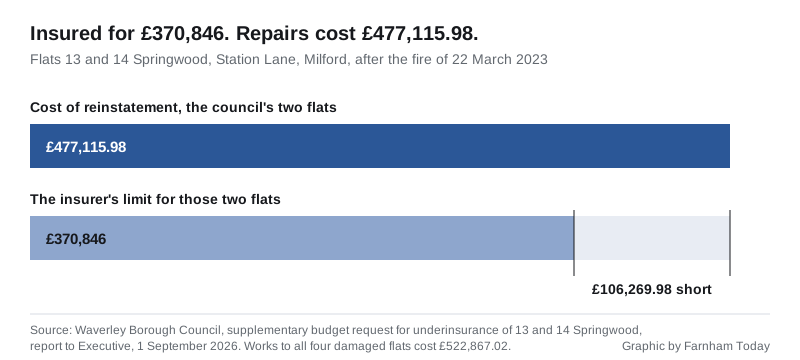
There is a wrinkle in how the sum is described. Paragraph 1.2 calls the £106,269.98 a settlement of “the underinsurance and excess for this incident”. Paragraph 6.2 arrives at the identical figure by subtracting the insurer’s limit from the cost of the works, which accounts for the whole amount as the shortfall alone.
Where the money comes from
Not from council tax. The recommendation is to take it from the HRA Working Balance Reserves, the reserve sitting behind the Housing Revenue Account, which is the ring-fenced account the council runs as a landlord and funds from its tenants’ rents.
Officers say the reserves “have been set aside for such instances” and are enough to cover it “without materially negatively impacting the overall reserve position for Waverley”.
The alternative option the report sets out is doing nothing, which it rejects: Sutton arranged the insurance, has already spent the money on Waverley’s behalf and the work was completed satisfactorily. The listed risks are to business continuity, to the housing account’s finances and to the relationship with Sutton.
It has already led to a review
The one forward-looking line in the report is paragraph 6.1. Since the shortfall came to light, “a comprehensive review of property reinstatement valuations has been undertaken and valuations have been updated where necessary to ensure that properties are adequately insured”.
The report does not say how many other council properties were found to be undervalued, or by how much.
Nor does it say why the cover on flats 13 and 14 was set at £370,846 when rebuilding them cost £477,115.98, or when that figure was last reviewed before the fire.
Why it is landing three and a half years later
The fire was in March 2023. The payment falls in the 2026/27 financial year, which is Waverley’s last: the borough is abolished on 1 April 2027 and replaced by West Surrey Council.
That timing is why the report spends a page on the Secretary of State’s section 24 direction, which stops the outgoing West Surrey councils signing certain contracts and land deals without the shadow authority’s written consent. Officers conclude it does not apply here, because this is an internal budget approval rather than a new contract, and the money will be paid before vesting day.
The council’s own financial procedure rules allow the Executive to approve supplementary estimates up to £250,000 where there is no ongoing revenue effect. This one is still going to full Council.
What it means for you
If you rent from Waverley, this comes out of the housing account rather than the general fund, so it is landlord money rather than council tax money. Officers say the reserve was there for exactly this and the overall position is not materially affected.
If you own a flat in a block where the council is the freeholder or a fellow owner, the useful detail is the review in paragraph 6.1. Reinstatement values across the council’s stock have been revisited since this claim, which is an admission that the sums insured had drifted behind rebuilding costs.
The decision runs in two stages, both in public:
- Tuesday 1 September, 7pm: the Executive is asked to recommend the supplementary estimate
- Tuesday 8 September, 7pm: full Council is asked to approve it
Both are in the Council Chamber at the Council Offices, The Burys, Godalming, and the papers are on the council’s website.
Our Farnham council tax bands page sets out what the borough charges, and district house prices are on our house prices page.
Have your say