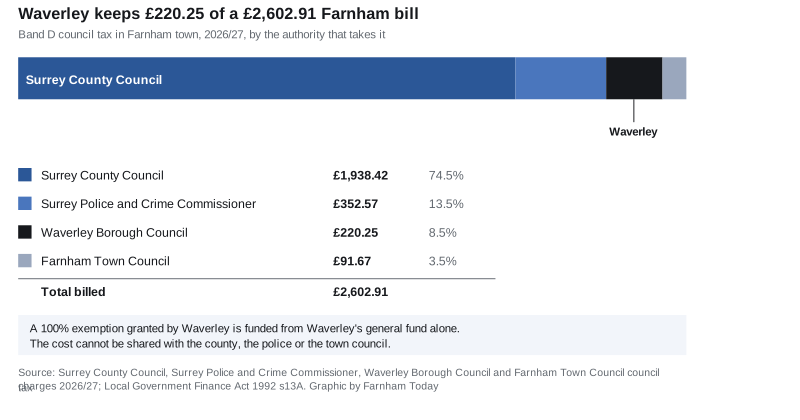

Councillors vote on 8 September on scrapping council tax for terminally ill households. Waverley would fund the whole £2,602.91 band D bill on its own.
Waverley councillors vote tonight on wiping the council tax bill of households where someone is terminally ill. It is item 14.1 at the full Council meeting at 7pm on Tuesday 8 September, in the Council Chamber at The Burys, Godalming.
The motion is proposed by Councillor Peter Clark and seconded by Councillor Mark Merryweather. It does not create a scheme by itself. It asks the Executive to go away and build one. (Motion on establishing Council Tax Relief for households with a terminally ill resident)
The motion asks the Council to agree three things:
- to note Marie Curie’s research on the extra costs faced by people with a terminal illness
- to accept that people at the end of life should not have to worry about council tax
- to request that the Executive considers a discretionary council tax relief scheme for terminally ill residents, “to operate as soon as possible”
What the motion says the problem is
The motion sets out the charity’s case. People living with a terminal illness often run higher energy bills, because heating and other utilities are part of managing symptoms. Household income falls at the same time, if the person or a carer has to cut back work or stop.
It also names the route into any such scheme. Relief is granted on receipt of an SR1 form, the medical evidence a clinician issues for fast-track access to benefits under the special rules for end of life. (Get benefits if you are nearing the end of life, GOV.UK)
The motion says 27 councils in England have introduced a 100 per cent exemption for terminally ill people, and names Elmbridge Borough Council as one of them. Marie Curie’s own campaign page gives the same figure of 27. (Marie Curie, council tax support at the end of life)
What it looks like where it already exists
Elmbridge is the nearest working example, so it is the clearest guide to what Waverley’s Executive would have to decide. Its scheme started on 1 April 2026. (Elmbridge council tax discretionary reduction scheme for households with a terminally ill resident)
The Elmbridge rules:
- the terminally ill person can be the taxpayer, a partner, a dependent child or a direct relative, of any age
- they must live at the property as their sole or main home
- an SR1 form is the qualifying evidence, issued where a clinician would not be surprised if the person lived less than 12 months
- the bill is reduced to zero, after every other discount and support is applied
- the award runs until three months after the person’s death, or from when they move to a hospice, care home or hospital, whichever comes first
- there is an overall cap of two years
- registered care homes and houses in multiple occupation are excluded
- changes of circumstance must be reported within 21 days
Elmbridge does not backdate before 1 April 2026, even where the SR1 form is older.
The bill Waverley would be picking up
This is where the arithmetic gets awkward, and it is the part the motion does not address.
The power comes from sections 13A(1)(c) and 13A(7) of the Local Government Finance Act 1992, which let a billing authority set a class of taxpayer and cut its council tax, including to nil. (Local Government Finance Act 1992, section 13A)
The cost falls on the borough alone. Elmbridge states it plainly in its own policy: “the financial burden of these reductions has to be met by Elmbridge Borough Council alone”. It cannot be shared with the county, the police or the town and parish councils.
Waverley collects the whole council tax bill but keeps very little of it. A band D household in Farnham town is billed £2,602.91 in 2026/27. Waverley’s own share is £220.25, or 8.5 per cent.
| Authority | Band D charge in Farnham |
|---|---|
| Surrey County Council | £1,938.42 |
| Surrey Police and Crime Commissioner | £352.57 |
| Waverley Borough Council | £220.25 |
| Farnham Town Council | £91.67 |
| Total | £2,602.91 |
So a 100 per cent exemption for one Farnham band D household costs Waverley £2,602.91 of its own money, not £220.25. It would be funding the county’s and the police’s share out of its general fund. Every band and every parish differs, and our Farnham council tax bands page has the full table.
That is why the design of the scheme, rather than the principle, is what the Executive will argue about. Councils that have costed a blanket version have found the range enormous. Newark and Sherwood District Council in Nottinghamshire put a 100 per cent scheme for every affected household at between £2.5m and £3.75m a year and called it unaffordable. It went instead for a narrow version, topping up existing council tax support recipients to 100 per cent, and budgeted £50,000. (Newark and Sherwood District Council, Council Tax Support for Terminally Ill Residents)
Those are not Waverley’s numbers. They show the size of the gap between the widest and narrowest versions of the same idea.
There is also a clock on it. Waverley is abolished on 1 April 2027 and its functions pass to West Surrey Council. Any scheme agreed this autumn would run for part of one financial year before the new authority inherits the decision.
What Waverley offers now
Nothing in this motion is needed for a household to ask for help today, and two things already exist.
Discretionary relief. Waverley already runs a section 13A hardship scheme. It is case by case rather than automatic, it asks for evidence of financial hardship and of income and expenditure, and it explicitly weighs “any social or health issues currently being faced by the resident and/or their immediate family”. The council calls it short term help, and awards end at the end of the financial year at the latest. The form is a download, or call 01483 523500. (Council tax discretionary relief)
An empty home exemption. If someone has moved permanently into a hospital or care home to receive personal care, the home they have left is exempt from council tax. (Empty property discounts and premiums)
What it means for you
If someone in your household has a terminal diagnosis, the SR1 form is the document that matters. Ask the clinician treating them whether one has been issued. It is the evidence every one of these council schemes is built on, and it also opens fast-track benefit claims. GPs and GMC-registered consultants send it to the DWP. (Send an SR1 medical evidence form, GOV.UK)
Do not wait for the vote. Apply for discretionary relief and check your council tax support entitlement now, because both exist today and any new scheme would take months to write.
If you want to follow the vote, the meeting is open to the public at The Burys, Godalming. The deadline for public questions was 5pm on Wednesday 2 September, so attending or watching is the remaining route. We will report the result.
Frequently asked questions
Is council tax free for terminally ill people in Waverley?
Not at present. Waverley councillors vote on 8 September 2026 on a motion asking the Executive to consider a discretionary scheme. Nothing changes on the night of the vote itself.
Which councils near Farnham already do this?
Elmbridge Borough Council, which introduced a 100 per cent reduction from 1 April 2026. Marie Curie counts 27 councils in England with a scheme.
What evidence would a household need?
An SR1 form, the medical evidence a clinician sends to the DWP where they would not be surprised if the person lived less than 12 months. It is the qualifying document in every scheme of this type, including Elmbridge’s.
What help can a Waverley household get today?
Council tax discretionary relief, which is means tested, short term and decided case by case, and council tax support. If someone has moved permanently into a hospital or care home for personal care, the home they have left is exempt.
Why would this cost Waverley more than its own share of the bill?
Because a reduction under section 13A of the Local Government Finance Act 1992 is funded by the billing authority alone. Waverley keeps £220.25 of a £2,602.91 Farnham band D bill, but it would carry the whole £2,602.91.
Related
- Farnham council tax bands, every band A to H and who takes the money.
- Farnham bin collection days.
- Farnham planning news.
Sources
- Waverley Borough Council, Motion on establishing Council Tax Relief for households with a terminally ill resident for the proposer, seconder, the three resolutions, the Marie Curie research summary, the SR1 requirement and the figure of 27 councils.
- Waverley Borough Council, Council agenda, 8 September 2026 for item 14.1, the venue and the public question deadline.
- Elmbridge Borough Council, council tax discretionary reduction scheme for households with a terminally ill resident for the 3 December 2025 determination, the 1 April 2026 start, the SR1 definition, the 100 per cent reduction, the three month and two year limits, the exclusions, the 21 day reporting duty and the statement that the cost falls on Elmbridge alone.
- Elmbridge Borough Council, terminally ill household members for the application route.
- Local Government Finance Act 1992, section 13A for the discretionary reduction power.
- Newark and Sherwood District Council, Council Tax Support for Terminally Ill Residents, January 2026 for the costed options, the £2.5m to £3.75m range, the £50,000 budget and the statement that section 13A awards cannot be passed to preceptors.
- Marie Curie, council tax support at the end of life for the figure of 27 councils.
- GOV.UK, get benefits if you are nearing the end of life and send an SR1 medical evidence form for what the SR1 form is and who completes it.
- Waverley Borough Council, council tax discretionary relief and empty property discounts and premiums for what is available today.
- Band D figures as set out on our Farnham council tax bands 2026/27 page, from Surrey County Council, the Surrey Police and Crime Commissioner, Waverley Borough Council and Farnham Town Council.
All sources checked on 8 September 2026.
Have your say