
Four of five homeowners who asked Waverley to review their CIL bills were turned down. One notice was defective and will be refunded. The six cases.
Four of the five householders who asked Waverley Borough Council to review their Community Infrastructure Levy bills have been turned down. The fifth, over a loft dormer, won: the council has ruled its own liability notice defective and will refund the levy.
The results are in a report to the council’s Overview and Scrutiny Committee, published for its meeting on Monday 14 September. It goes to the Executive on 6 October. (Outcome of the CIL Discretionary Review, Waverley Borough Council)
The review was the council’s answer to residents who say they were unfairly charged the levy on extensions and home rebuilds. The bills in the six cases range from £36,460 to £100,124.
The six cases
The review ran from July 2025 to July 2026 and drew six applications. An independent reviewer looked at each one, and the Director of Planning made the final decision. Five have been decided.
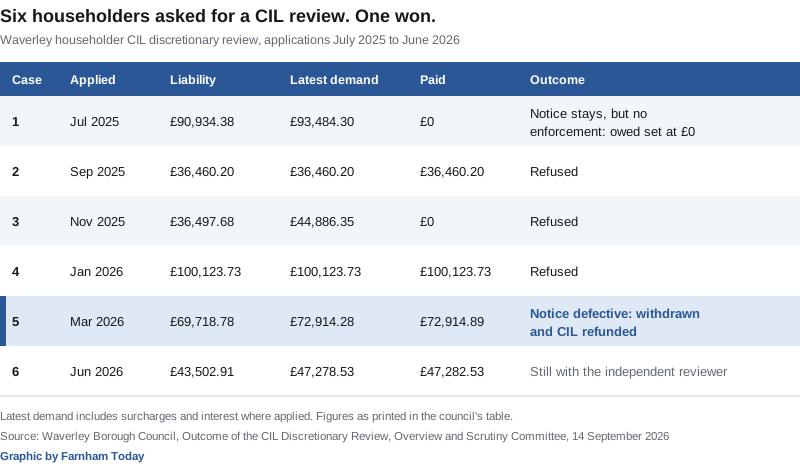
What happened in each, according to the report:
- Case 1, 2021 permission, bill £90,934.38. The notice stays. But the council admits it wrongly believed it needed a further form before it could confirm the householder’s exemption. Because of that, it will not enforce the debt. A note on the land charge will record the sum owing as £0.
- Case 2, a replacement self-build home, £36,460.20. Refused. The owners sold the house, and a self-build exemption ends on a sale within three years of completion. They disputed the floor area five years after the notice, not at the time.
- Case 3, extensions to create two flats, £36,497.68. Refused. Internal demolition and foundation digging began before the required commencement notice. The report accepts the applicant “may have made a genuine mistake”, but says the regulations leave no room to withdraw the notice.
- Case 4, extensions including a basement, £100,123.73. Refused. The owner did not live in the house when claiming the extension exemption, which the law requires. The bill was paid in full in June 2024.
- Case 5, dormer windows and rooflights, £69,718.78. Won. The planning permission covered only the dormers, about 5 square metres. The CIL officer had treated the whole loft conversion as the development; the planning officer had not. The reviewer found there was no chargeable development at all.
Case 6, with a demand of £47,278.53, is still with the independent reviewer. The individual decisions were published on the council’s register on 8 and 9 September. (Case 1, Case 3, Case 4, Case 5, Case 2)
What the council admits went wrong
The report lists a “lesson learnt” for two cases and none for the other three.
In case 1, an officer believed an assumption of liability form was needed before the exemption could be granted. It was not. The report says every member of the team now knows to grant exemptions “as soon as practically possible”.
In case 5, two officers in the same planning service took different views of what the development was. The report says the matter should have gone to a senior officer. It adds that it is “confident” that would happen now.
The report also concedes the reviews “have taken considerable time”. It says they had to be weighed against other priorities, such as enforcement against unauthorised building work.
The investigation still has no brief
Full Council voted on 27 January 2026 for an independent investigation into how the planning department issued and enforced CIL notices on homeowners. Eight months on, nobody has been appointed.
The report sets out why:
- the Planning Advisory Service said investigating a council’s behaviour is outside its remit
- the Planning Officers’ Society would quote for the work, but only for a specific case or event, with evidence to look at
- the motion did not say what period, which cases or which “behaviours and practices” to examine
Scrutiny councillors were asked to answer those questions so the Executive can write a brief. The cost is unbudgeted. Depending on its size, the contract may also need consent from the West Surrey Shadow Authority.
Six residents put written questions to the committee, all on CIL. One quoted a March promise from Councillor Liz Townsend, the planning portfolio holder, that a report setting out the scope would go to the Executive in May 2026. The committee’s published answer said it was “not in a position to answer” why that did not happen. (Questions from Members of the Public, 14 September 2026)
A second inquiry, by councillors
On 30 June a motion titled “Householder CIL: Lack of Progress” was carried at full Council by 22 votes to 20. It asked scrutiny councillors to set up their own task and finish group, with power to seek outside help.
That group was put to the same 14 September meeting for formal approval. The report notes that work had already started, with a scoping workshop on 11 August. (CIL Task and Finish Group report; minute of the 30 June motion)
What the minister said
Housing minister Matthew Pennycook wrote to every CIL charging authority in England on 25 June 2026. His letter confirms councils have discretion over enforcement. It also confirms they have none where a householder did not follow the exemption procedure before starting work. (Community Infrastructure Levy charges on householders: letter to local authorities, GOV.UK)
Waverley’s report reads one more point from it. In exceptional cases, a council can make its own payments to householders from its general fund. But those payments “would not constitute a waiver or refund of CIL”, so the debt itself would remain. The report says a minister’s letter “does not change the law”.
What it means for you
If you are planning an extension, annexe or self-build anywhere in the borough, these cases show where the money is lost:
- Claim the exemption before you start. Every refused case turned on work beginning before an exemption was confirmed, or the conditions for it not being met.
- “Starting” includes small jobs. In case 3, internal demolition and digging foundations counted as commencement.
- You must live in the house when you claim the extension exemption, not just intend to later.
- A self-build exemption is lost if you sell within three years of completion.
- Challenge a floor area at the time. A Regulation 113 review, then an appeal to the Valuation Office Agency, is the route. It cannot be used once work has begun.
If you have a CIL bill you believe is wrong, the review window closed in July 2026. The report goes to the Executive on 6 October, and councillors’ task and finish group is the other place the issue is still live. For current planning decisions in the borough, see our Farnham planning news.
CIL in the borough passes to West Surrey Council when Waverley is abolished on 1 April 2027.
Frequently asked questions
What is CIL on a house extension?
The Community Infrastructure Levy is a charge on new floor space that funds local infrastructure. Waverley’s charging schedule took effect on 1 March 2019. Development adding more than 100 square metres can be liable, but householders can claim an exemption if they own and live in the home and apply before work starts.
How many Waverley householders won their CIL review?
One of the five decided so far. Case 5 had its notice withdrawn and the levy refunded. In case 1 the notice stands, but the council will not pursue the unpaid sum.
Is Waverley investigating its planning department over CIL?
Council voted for an independent investigation on 27 January 2026. As of the 14 September report, no investigator had been appointed because the scope had not been agreed.
Can Waverley refund CIL it has lawfully charged?
The report says no. It can only withdraw a notice that is defective or was not served properly. The minister’s letter says a council can make its own payments in exceptional cases, but they do not cancel the CIL debt.
Sources
- Waverley Borough Council, Outcome of the CIL Discretionary Review and update on previous Council resolutions, Overview and Scrutiny Committee 14 September 2026, Executive 6 October 2026
- Waverley Borough Council, Overview and Scrutiny Committee, 14 September 2026, agenda and papers
- Waverley Borough Council, Questions from Members of the Public, 14 September 2026
- Waverley Borough Council, officer decision records for cases 1 and 5
- MHCLG, Community Infrastructure Levy charges on householders: letter to local authorities, 25 June 2026
Have your say