
From 31 October, extensions and schemes of up to nine homes go to officers, however many object. Waverley's planning committee shrinks from 15 seats to 13.
From 31 October, no number of objection letters will be able to send a small planning application to Waverley’s planning committee. An officer will decide it, and that will be the end of it.
The change is not the council’s idea. A national scheme of delegation for planning comes into force across England on 31 October 2026, and it dictates which applications councillors are allowed to vote on. Waverley’s full Council is asked to put it into the constitution on 8 September. (Implementation of the National Scheme of Delegation for Planning Functions, report to Council, 8 September 2026)
There is no vote on whether to do it. Officers spell that out: “the only option available is for the Council to make the changes”. Miss the deadline and any decision taken outside the national scheme can be judicially reviewed by anyone unhappy with it.
What can never go to committee again
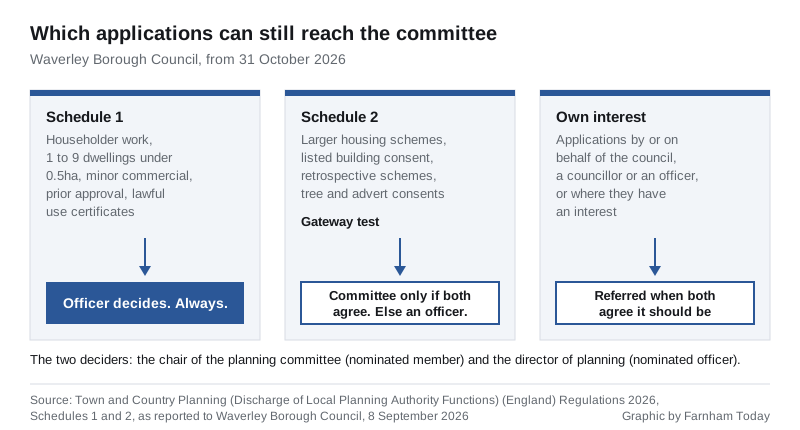
The Town and Country Planning (Discharge of Local Planning Authority Functions) (England) Regulations 2026 sort applications into two schedules. Schedule 1 applications must be decided by an officer and cannot be referred to committee at all. (Appendix 4, extract of Schedules 1 and 2)
Schedule 1 covers most of what actually lands on a Farnham street:
- householder applications, meaning extensions and alterations to an existing house or work within its grounds
- minor residential applications: between one and nine dwellings on a site smaller than 0.5 hectares
- minor commercial applications, as defined in the development management order
- applications to vary or drop conditions on any of the above
- non-material amendments to a permission already granted
- certificates of lawful existing or proposed use
- prior approval applications under permitted development rights
- reserved matters on an outline permission, unless that outline was for 500 or more homes or 50,000 square metres or more of floorspace
(Regulation 2, interpretation; article 2, Town and Country Planning (Development Management Procedure) (England) Order 2015)
Under the scheme Waverley runs today, plenty of those would be pulled in to committee automatically, on a ward member’s call-in or once enough letters arrived from the public. The report is blunt about what happens to that: “This will no longer apply.”
The gateway test, and the two people who apply it
Schedule 2 is the bigger stuff: full planning applications that are not householder, minor residential or minor commercial; listed building consent; retrospective applications; tree preservation order consents; advertisement consents; reserved matters on outline permissions for 500 homes or more.
These are presumed to be officer decisions too. They only reach the committee if two named people both agree they should, a “nominated member” and a “nominated officer” applying a gateway test set by regulation 5(3). They must ask whether the application raises:
- one or more issues of economic, social or environmental significance to the local area, or
- one or more significant planning matters, having regard to the development plan and other material considerations
If the two of them disagree, an officer decides. There is no casting vote and no appeal to the committee.
The council is being asked to appoint the chair of the planning committee, currently Councillor Penny Rivers, as its nominated member, and the director of planning, Claire Upton-Brown, as its nominated officer. That recommendation came from the Guildford and Waverley Joint Standards Committee on 24 August. The director of planning has said she does not want a substitute; the nominated member will have one.
Government guidance narrows it further. An application that broadly complies with a site allocation and the relevant local, neighbourhood and national policies is “unlikely” to raise a significant planning matter. Nor is one where a statutory consultee raised a concern about, say, highways or flood risk and the scheme was then changed to satisfy them.
The two of them may also agree a triage process in advance, and the report asks for delegated authority to set one up. It gives examples of whole categories that could be signed away to officers: applications to modify section 106 obligations, tree preservation consents, advertisement consents.
Fifteen seats become thirteen, and Farnham loses two
The regulations cap planning committees at 13 members. Waverley’s has 15, so it has to be rebuilt.
The Joint Standards Committee recommended keeping it at the maximum of 13 rather than going smaller. Political proportionality then does the rest. On the council’s current composition, the largest remainder method produces this:
| Group | Council seats | Committee now | Committee from 31 Oct |
|---|---|---|---|
| Liberal Democrats | 24 | 6 | 6 |
| Farnham Residents and Aligned Independents | 12 | 5 | 3 |
| Conservatives | 10 | 3 | 3 |
| Unaligned Independents | 2 | 1 | 1 |
| Green | 1 | 0 | 0 |
| Total | 50 (one vacancy) | 15 | 13 |
The Farnham Residents and Aligned Independents group loses two of its five seats. Its leader has to decide which two members come off, and tell the director of democracy and governance before 31 October.
What the council expects the effect to be
The report does not dress this up. Paragraph 6.7 says the likely overall effect is to reduce the number of applications going to committee, and that the changes “will reduce the instances of residents attending Planning Committee to make verbal representations on applications of interest to them”.
Officers also record that “the planning profession is rightly concerned about the shift of responsibilities from committee to officers”. The Planning Officers’ Society has advised councils to guard against lobbying of individual officers now that they carry the decision alone. Extra wording has been added to Waverley’s Planning Code of Good Practice, and the report floats a future procedure for dealing with vexatious complaints.
What it means for you
If your neighbour applies for an extension, a loft conversion or a change to an existing permission, you can still object and the officer must still take your objection into account. What you can no longer do is get it heard in public in front of councillors. From 31 October there is no threshold of letters, and no ward councillor call-in, that will move it.
If you are objecting to something bigger, the committee route still exists. That means a housing scheme too large to count as minor residential, a listed building consent in Farnham town centre, or a retrospective application. But it is now a decision two people take about your case before the case is heard, rather than something triggered by the level of local objection.
Three dates matter:
- Tuesday 8 September, 7pm: full Council is asked to approve the changes and reconstitute the committee
- Saturday 31 October: the regulations take effect and the new scheme of delegation starts
- The first committee meeting after that date: the 13-member committee replaces the 15
None of it stops at the borough boundary or at abolition. Waverley disappears on 1 April 2027 and West Surrey Council takes over, and the report notes the national scheme “will need to be adopted by West Surrey Council” too.
We track applications as they come through on our Farnham planning news page.
Have your say