

What Waverley would fine landlords under the Renters' Rights Act: £35,000 for illegal eviction, £6,000 for refusing a tenant on benefits. Scrutiny, 10 Sept.
Waverley Borough Council has published the fines it intends to charge landlords under the Renters’ Rights Act 2025. The highest starting point is £35,000, for unlawfully evicting or harassing a tenant.
The figures sit in a new Joint Civil Financial Penalty Policy, written with Guildford Borough Council. It goes to the Guildford and Waverley Joint Overview and Scrutiny Committee on Thursday 10 September, then to the Joint Executive Committee on 6 October. The council’s decision record gives an effective date of 26 October 2026. (Private Sector Housing Standards Policy Review)
This matters to more Waverley households than most council papers. At the 2021 census, 17,238 residents of the borough lived in privately rented homes, close to one in seven of everyone living in a household here. (ONS, Census 2021, tenure of household, Waverley)
What each breach would cost
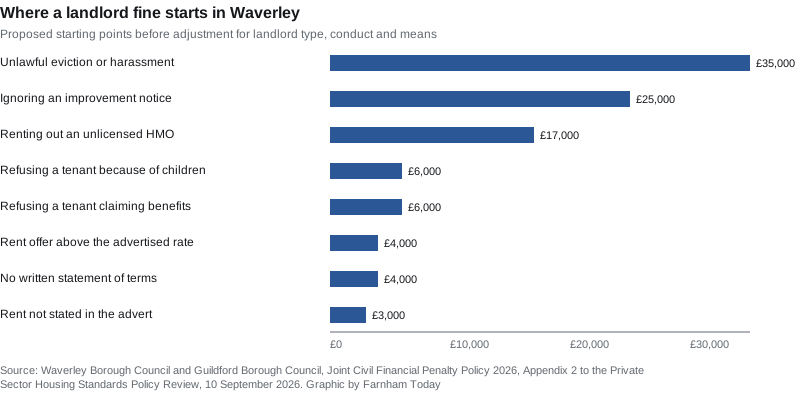
Central government sets the starting points for most offences. Waverley and Guildford set their own only for breaches of licence conditions. These are the levels a landlord in Farnham, Godalming or Haslemere would face first.
| Breach or offence | Starting point | Legal maximum |
|---|---|---|
| Unlawful eviction or harassment | £35,000 | £40,000 |
| Ignoring an improvement notice | £25,000 | £40,000 |
| Renting out an unlicensed HMO | £17,000 | £40,000 |
| Refusing a tenant because of children | £6,000 | £7,000 |
| Refusing a tenant because they claim benefits | £6,000 | £7,000 |
| Taking a rent offer above the advertised rate | £4,000 | £7,000 |
| No written statement of tenancy terms | £4,000 | £7,000 |
| Not stating the rent in the advert | £3,000 | £7,000 |
Two rules make those numbers bigger than they look.
- A separate penalty can, and usually will, be imposed for each breach. Three failings at one property means three fines.
- Where several landlords are responsible for the same breach at the same property, each one is fined separately.
How the figure moves up or down
Officers then adjust the starting point in steps. The first step is the type of landlord, and it is worth 20 per cent either way.
An upward adjustment of 20 per cent applies if any one of these is true:
- the landlord has at any time owned, controlled or managed six or more properties
- they have at any time run three or more houses in multiple occupation
- they are a corporate landlord, or have been a director of one
- the council judges them to have significant letting experience
A downward adjustment of 20 per cent applies only if all of the following are true: no more than two properties ever held, no more than one HMO ever held, and very limited experience.
So the same illegal eviction starts at £28,000 for someone letting a single flat and £42,000 for a portfolio landlord, before anything else is counted. Mitigating and aggravating factors can then move it by up to a further 20 per cent, and financial circumstances are considered after that. Nothing can exceed the statutory ceiling of £7,000 or £40,000.
For unlawful eviction the policy lists four aggravating factors specific to the offence: violence or threats of violence, disposing of a tenant’s possessions or threatening to, breaching an injunction, and loss of the home.
Why the council is doing this now
Waverley’s existing private sector housing enforcement policy was last reviewed in January 2023. Guildford’s dates from September 2022. Both predate the Act.
The report says the 2025 Act turns enforcement from something councils may do into something they must do. Section 107(1) places a statutory duty on the council to enforce landlord legislation in its area.
The report also sets out what else is coming for private renters:
- a Decent Homes Standard applied to private rented homes for the first time
- a mandatory national register of landlords and properties, with fines for not registering and a bar on serving a valid possession notice
- a Private Rented Sector Landlord Ombudsman that landlords must join
- a minimum energy efficiency standard of EPC C for private rented homes
- strengthened rent repayment orders, which pay money back to the tenant
On that last point, the report notes the English Housing Survey for 2023 found 48.4 per cent of private rented homes in England were rated EPC C or above.
The money, and the staff
Fine income cannot be treated as revenue. The report is explicit: money from civil penalties must be spent on the council’s private rented sector enforcement work, and anything not spent that way goes to central government.
Central government has paid new burdens funding to cover the extra work:
| 2025/26 | 2026/27 | |
|---|---|---|
| Waverley Borough Council | £28,000 | £60,000 |
| Guildford Borough Council | £41,000 | £81,600 |
The report is candid that the risk is people rather than money. It says there are “resource risks in relation to the ability to recruit sufficient staff”, and that this is “particularly problematical given the imminent creation of West Surrey Council”. Waverley is abolished on 1 April 2027. Officers say the duty carries across to the new authority.
There is a smaller sign of a document still being finished. The complaints section of the draft enforcement policy, as published in the agenda pack, tells residents to write to the councils “by email at [EMAIL ADDRESS] or by post at: [PHYSICAL ADDRESS]”. The placeholders have not yet been filled in.
What it means for you
If you rent privately in Waverley. The council’s existing route has not changed while the policy is in progress. Waverley asks you to put disrepair to your landlord or agent in writing first and allow at least 14 days unless it is urgent, then complain to the council if there is no adequate response. (Problems with disrepair) Keep the written trail. The policy leans heavily on evidence of what the landlord was told and when.
If you let a property here. Three of the penalties above catch things that are easy to get wrong rather than deliberate: no written statement of terms, no rent figure in the advert, and accepting an offer above the advertised rent. Each starts at £3,000 to £4,000, and each is charged per breach.
If you want to speak on it. The Joint Overview and Scrutiny Committee meets at 7pm on Thursday 10 September. Only scrutiny comments are invited at that stage; the decision itself is for the Joint Executive Committee on 6 October.
Frequently asked questions
What is the biggest fine Waverley could charge a landlord?
£40,000. That is the statutory maximum for the more serious offences, including unlawful eviction, ignoring an improvement notice and running an unlicensed HMO. The proposed starting point for unlawful eviction is £35,000, and a portfolio landlord starts 20 per cent higher, at £42,000, capped back to £40,000.
When do the new landlord fines take effect in Waverley?
The policy goes to the Guildford and Waverley Joint Overview and Scrutiny Committee on 10 September 2026 and to the Joint Executive Committee on 6 October 2026. The council’s decision record gives an effective date of 26 October 2026.
Can a landlord in Farnham be fined for refusing tenants on benefits?
Yes, under section 34 of the Renters’ Rights Act 2025. The proposed starting point is £6,000, with a statutory maximum of £7,000. Refusing a tenant because they have children carries the same starting point.
Who do I tell if my rented home in Waverley is in disrepair?
Put it in writing to your landlord or letting agent first and allow at least 14 days unless it is urgent. If there is no adequate response, complain to Waverley Borough Council through its problems with disrepair page.
Does the council keep the fines it charges?
Not as general income. The report says money from civil penalties must be spent on the council’s private rented sector enforcement work, and anything not spent that way is paid to central government.
Related
- Farnham house prices, what buying costs against renting.
- Farnham council tax bands, who charges what on a bill.
- Farnham planning news.
Sources
- Waverley Borough Council, Private Sector Housing Standards Policy Review, report to the Joint Overview and Scrutiny Committee on 10 September 2026 and the Joint Executive Committee on 6 October 2026, for the recommendations, the 2023 and 2022 policy review dates, section 107(1), the Decent Homes Standard, the national register, the ombudsman, the EPC C standard, the 48.4 per cent figure, the new burdens funding, the ring-fencing of penalty income and the recruitment risk.
- Appendix 2, Joint Civil Financial Penalty Policy 2026 for every starting point, the £7,000 and £40,000 statutory maximums, the landlord type adjustments and their criteria, the per-breach rule and the offence-specific aggravating factors.
- Appendix 1, Joint Private Sector Housing Enforcement Policy for the duty under section 5 of the Housing Act 2004 and the unfilled contact placeholders in the complaints section.
- Waverley Borough Council, decision record, Private Sector Housing Enforcement Policy for the publication date of 1 September 2026 and the effective date of 26 October 2026.
- Waverley Borough Council, Guildford and Waverley Joint Overview and Scrutiny Committee, 10 September 2026 for the meeting and the agenda pack.
- Waverley Borough Council, problems with disrepair for the reporting route.
- ONS, Census 2021, tenure of household, Waverley: 14,627 usual residents in accommodation rented from a private landlord or letting agency and 2,611 in other private rented accommodation, out of 124,353 usual residents in households.
All sources checked on 8 September 2026.
Have your say