

Surrey is short of foster carers. You can foster if you rent, live alone or have no children; carers here are 24 to 86. Two Surrey carers tell how it went.
Surrey County Council’s fostering service is asking more people across the county, Farnham and Waverley included, to think about becoming foster carers. The service says the number of fostering households is falling, both nationally and in Surrey, and that many people who would make good carers rule themselves out before they have asked.
It points to recent government-supported research which, the service says, found that many people believe they could foster well but decide they cannot “because of misconceptions around eligibility, income, home ownership or family circumstances”.
“Fostering families come from many different backgrounds, and what children need most is someone who can offer stability, encouragement and care,” the fostering service told Farnham Today. “We’re particularly keen to challenge common myths around fostering and encourage local residents to have a conversation before deciding fostering is not for them.”
“I was the complete opposite”
Ben is one of the carers the council put forward. The service says he began by offering respite care and went on to give a long-term home to a young person who has now grown into adulthood, a story it describes as showing “how fostering often begins with a simple desire to help and grows into something life-changing for both the child and carer”.
In his own account on the council’s fostering stories pages, Ben, now a fostering ambassador, describes the carer he assumed he would need to be:
“If you’d asked me six years ago who I thought a typical foster carer was, I’d probably have made general assumptions: a married couple, with existing experience as parents; and a semi-detached house, complete with a white picket fence. I was the complete opposite.”
The pandemic, he writes, gave him time to take stock. His job had been furloughed, he had “a flat large enough for me to rattle around in”, and the part of his work he had enjoyed most was “helping others to develop their careers”. He calls the application process “reassuringly thorough”:
“Fostering isn’t an impulsive decision. You need time to make sure it’s what you want. I know we live in a world of immediacy and next-day deliveries, but I don’t think you can rush the process. And given I was potentially being entrusted with a young person, it made sense to ensure that I was a good match for the role. If the assessing social worker hadn’t chatted to my friends and family, I would have been worried.”
Approval took around six months, he says. Then came “a wave of emotions, excitement matched by pure anxiety”. Caring for a teenager, he writes, has been much like his friends’ experience with their own teenage children: “I’m constantly picking up discarded socks and the carton of fruit juice always seems empty.”
“Yes, there have been challenges, even times when I’ve considered whether I’ve made a mistake. But the good times have massively outweighed the bad. And it’s given me a sense of purpose that I don’t think I had before.”
And his conclusion: “I might not have years of previous parenting experience, a significant other or even a white picket fence, but I’m extremely proud of the contribution I can make through fostering. It’s not about what I have, but rather what I can offer.”

“Your different way of thinking might be exactly what a young person needs”
Cindy, the second carer whose photograph the council sent, has fostered for many years. She is a retention ambassador for the service, a Fostering Buddy and part of what she calls a “Mockingbird constellation”, and she has ADHD and dyslexia. Writing for ADHD Awareness Month this October, she addresses people who have assumed fostering is not for them:
“You can have ADHD, dyslexia or another disability and still foster, and still make a real difference to a young person’s life.”
She is open about what is hard. “Organising dates, times and meetings is a real challenge for me,” she writes; a large electronic calendar and to-do list now keeps her on track. But she says the way she thinks helps with the young people in her home:
“I’m also very aware of what’s going on around me. That might be my ADHD, or growing up in care, or probably a bit of both. I tend to notice body language and small changes in mood, which can be really helpful with young people who’ve learned to hide how they’re feeling.”
“Many of the young people who’ve lived with me feel they’re never good enough, because they don’t fit the social norms that the world expects… Watching a young person realise ‘I can do this’ is one of the most rewarding parts of fostering.”
“Fostering has made my life so much bigger,” she writes, listing rollercoasters, long bike rides and travel with the young people she has cared for. “If you’re neurodivergent and you’ve ever thought ‘fostering isn’t for people like me,’ please think again. You won’t be doing it alone.”
In an earlier piece on keeping carers in fostering, Cindy is frank about why some leave: “often carers don’t leave because they stop caring. If anything, they can care too much.” Her advice to carers who are struggling is to “talk to your retention ambassador. Tell us what’s working, but more importantly, tell us what isn’t.”
The council’s film
The fostering service has also made a short film, The Run, which it describes as a fostering story “of hope, trust and belonging”.
Who can foster in Surrey
The council’s Who can foster page answers the questions that put most people off:
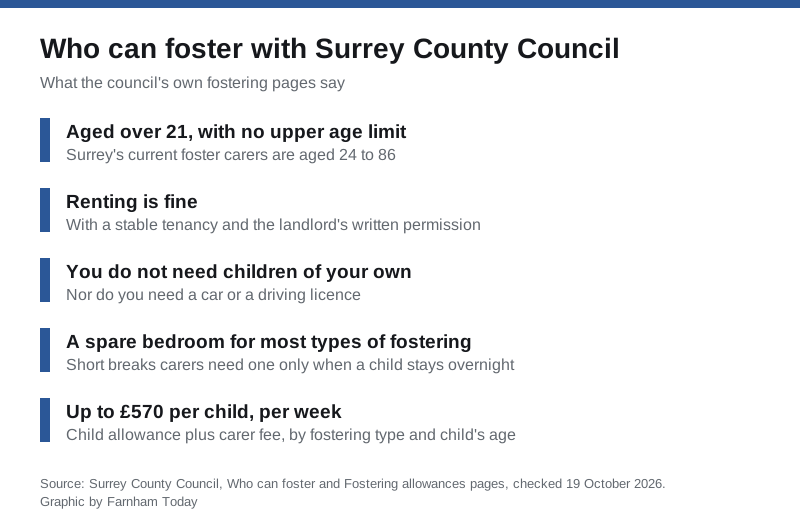
- Age: you need to be over 21. There is no upper limit, and the council’s current foster carers are aged 24 to 86.
- Renting: you can foster from a rented home with a stable tenancy and your landlord’s written permission.
- Children of your own: not needed. Some experience with children, through work, volunteering or family, helps but is not essential.
- A car: not needed, though you will need reliable public transport or people nearby who can help with school runs, appointments and family visits.
- A spare room: needed for most types of fostering. Babies can usually share your room until around 36 months, and short breaks carers need a room only when a child stays overnight.
- Work: you can work full-time as a short breaks or supported lodgings carer. Fostering a school-age child while working needs friends or family to help outside school hours, and for pre-school children or parent and child fostering one carer must be at home full-time.
On money, the council’s fostering allowances page says the child allowance and carer fee together come to up to £570 per child per week, depending on the type of fostering and the child’s age, and up to £1,102.57 a week for parent and child fostering. Most new carers start at its Payment Level 2, which pays from £331.54 a week for a child aged up to four to £496.58 for a 14 to 17-year-old (figures checked 19 October 2026).
What it means for you
If you live in Farnham or anywhere in Surrey and have wondered about fostering, the service’s message is to ask before deciding it is not for you. It offers several ways in, all on its contact page:
- call 01372 832929, Monday to Friday, 9am to 5pm
- book a callback or order a brochure
- try the council’s ‘Could I Foster?’ quiz
- read more carers’ own accounts on its fostering stories pages

Have your say