
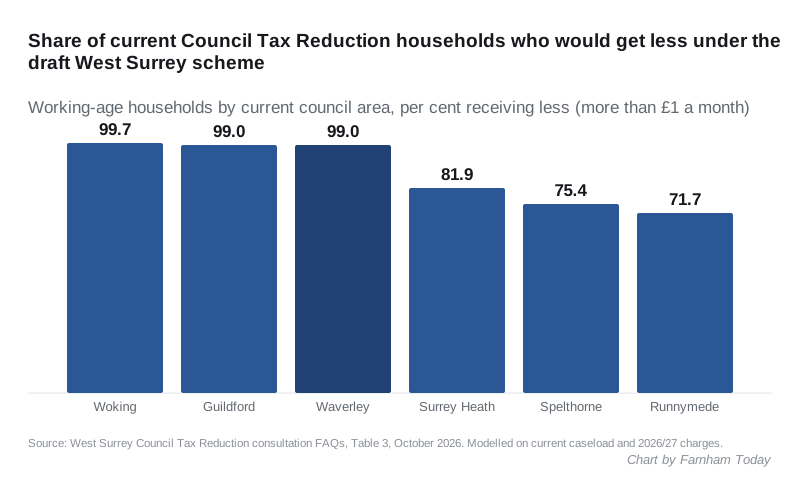
Waverley's working-age claimants get up to 100% off council tax now. The draft West Surrey scheme caps help at 85%, so 2,243 of 2,265 would get less.
Almost every working-age household in Waverley that gets help with council tax would get less from April 2027 under a draft scheme for the new West Surrey Council.
The council’s own modelling says 2,243 of Waverley’s 2,265 working-age Council Tax Reduction households would receive less. That is 99%. One household would receive more and 21 would be broadly unchanged. The figures are in the consultation’s frequently asked questions, and the consultation is open until 3 December.
Why Waverley is hit hardest
Council Tax Reduction, or CTR, cuts the bill for people on low incomes. It is credited to the council tax account, not paid as cash.
Waverley, Guildford and Woking currently offer a maximum of 100%, so the poorest working-age claimants pay nothing. The draft West Surrey scheme would cap help at 85%. The FAQs say moving to 85% “produces a reduction for nearly all current claimants in those areas”.
West Surrey Council replaces Waverley and five other councils on 1 April 2027. It needs one scheme in place of the six it inherits from Guildford, Runnymede, Spelthorne, Surrey Heath, Waverley and Woking.
What the draft scheme proposes
The FAQs list the main features:
- A maximum award of 85%. Every working-age claimant would pay at least 15% of their bill.
- Help capped at Band D. Homes in Bands E to H would pay the whole difference above the Band D charge.
- A £6,000 savings limit. Households with more than £6,000 in savings or capital would not qualify. The home you live in does not count.
- A 20% taper. Help falls by 20p for every £1 of income above the household’s assessed needs.
- A flat £10 a week deduction for each other adult living in the home, such as a grown-up son or daughter.
- A Minimum Income Floor for self-employed claimants after a 12-month start-up period.
- Up to three months’ backdating.
What it would cost claimants
The six existing schemes give about £19.44 million a year in working-age support. The draft is modelled at about £16.30 million, around £3.13 million less. That is a 16.1% cut.
The FAQs are plain about where that money comes from: “more Council Tax is billed to affected low-income households.”
Across West Surrey, 10,683 households (87.8%) would get less, and 1,349 would get more. Other figures in the document:
- 149 current claimants have savings above £6,000 and would lose their support entirely.
- 811 households with another adult living at home would get less because of the £10 deduction.
The consultation’s illustration uses a West Surrey average Band D charge of £2,559.13. On that figure, a Band D household on the maximum award would pay at least £383.87 a year. A Band E household would pay at least £952.57.
In Farnham this year, Band D is £2,602.91. Fifteen per cent of that is £390.44 a year. A Farnham claimant on the full award pays nothing towards that bill today. The 2027/28 charges have not been set yet, so these are illustrations only.
What it means for you
- Pension-age claimants are not affected. Their support follows national rules, and this consultation covers working-age residents only.
- Nothing changes yet. Current awards carry on under Waverley’s rules until any new scheme starts on 1 April 2027.
- Responding will not affect your claim. The FAQs say responses cannot be used to identify anyone or decide an award.
- Transitional protection has not been decided. It would be temporary support for some existing claimants. Who gets it, and for how long, depends partly on the consultation.
- A hardship route stays. The council says it will keep separate support for exceptional hardship.
How to have your say
The consultation runs until 3 December 2026. Details, the easy read booklet and worked examples are on the Surrey LGR hub consultation page.
Paper copies and help over the phone are available on 01276 707100. Surrey Heath Borough Council’s contact centre takes those calls for West Surrey. You can also email ctrswestsurrey@surreylgrhub.gov.uk.
Five options were modelled, with maximum awards of 100%, 95%, 90% and 85%, plus an income-banded design. The 85% option was put forward as the draft. The council expects to decide the final scheme in January 2027.
Have your say