
Farnham Voice wants residents' associations and community groups to share their plans in a working group and a public board, starting with Neighbourhood CIL.
Farnham’s residents’ associations and community groups are being invited to work together: to share what they are working on, learn from each other and coordinate where their priorities overlap.
Farnham Voice, a community platform that says it is not affiliated with the council, has published a proposal for a community working group and a public online board showing what each group is working on. It sees the Neighbourhood CIL pilot, which uses funding raised from local development to pay for community improvements, as a timely opportunity to start. The council has not yet published its guidance on the pilot for Farnham; Farnham Voice says it is expected next week.
“Bringing Farnham’s residents’ associations and community groups together isn’t a new idea,” the group said. “It’s something we’ve been encouraging for months, and the upcoming Neighbourhood CIL Pilot could be our best opportunity yet to make it happen.”
What is being proposed
There are two parts. The first is a working group “where local associations can share proposals, learn from each other’s experiences and coordinate efforts where their priorities overlap.”
Farnham Voice calls that “the most important part of the proposal” in its full write-up: “If one association runs into a problem with an application, others could learn from it and adapt their approach. If several groups are pursuing similar improvements, they could share information, coordinate resources and potentially strengthen their applications.”
It says it has also suggested to the council a meeting with representatives of local community groups, “so questions can be asked and answered in one place.”
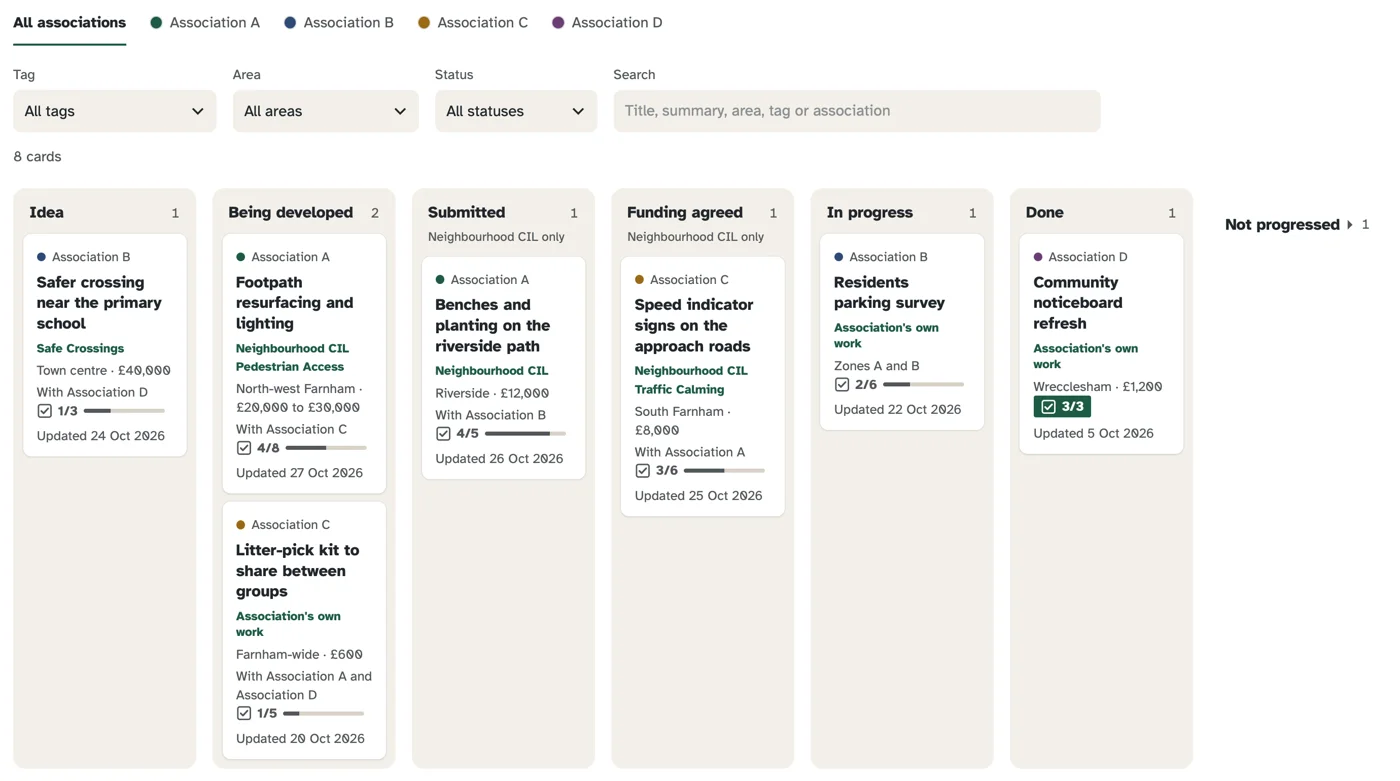
The second part is a public board, viewable by anyone without signing in, “where residents could see what groups are working on, who’s leading each proposal and how things are progressing.”
Each proposal would be a card in a column showing how far it has got: Idea, Being developed, In progress, Done, or Not progressed. Neighbourhood CIL bids would have two extra stages, Submitted and Funding agreed. Cards can be tagged, for example Safe Crossings, Traffic Calming or Pedestrian Access, and filtered by association and by area of Farnham.
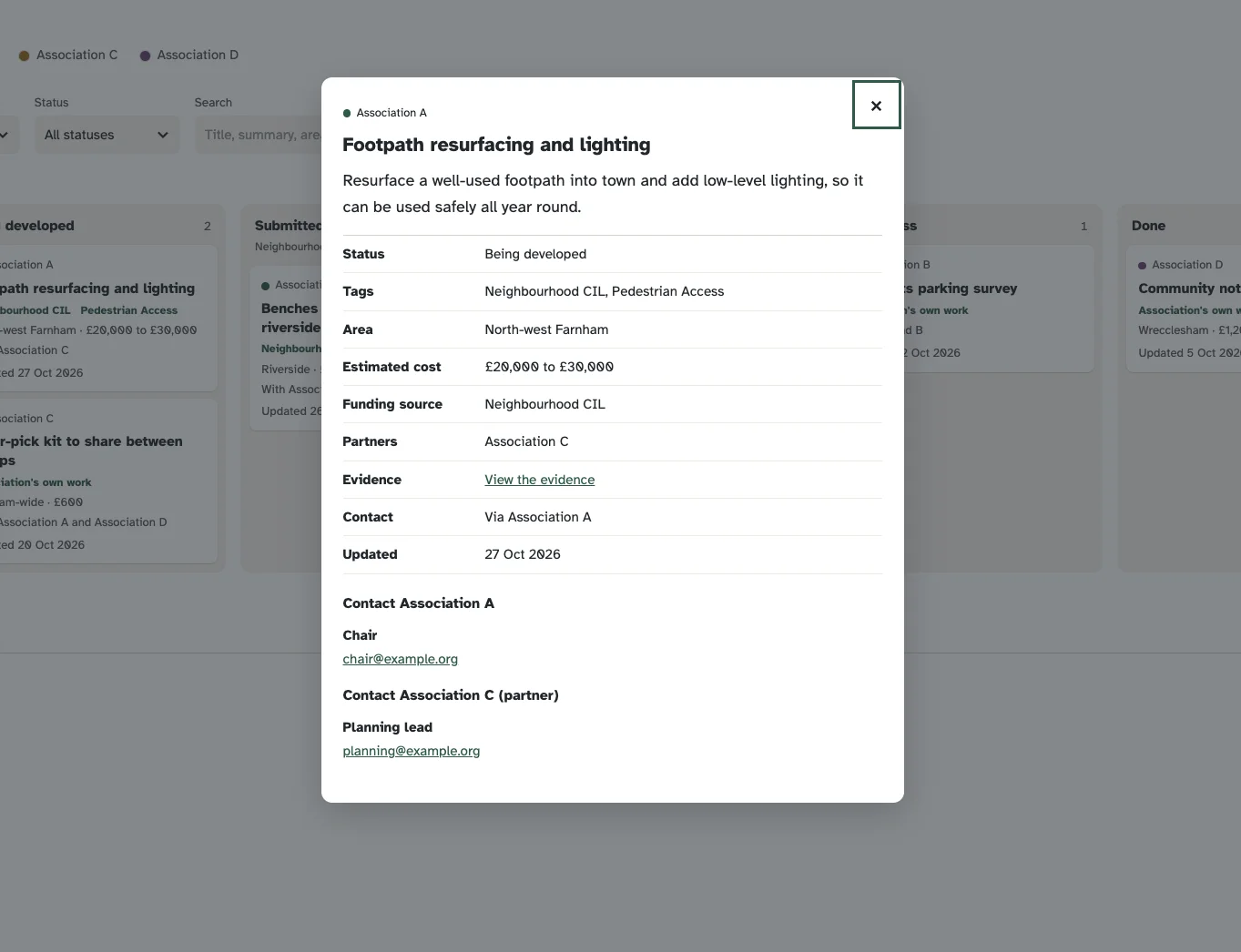
Opening a card shows a summary, the stage, the area, an estimated cost, the funding route, partner associations, a link to the evidence and who to contact. The group says each association would manage its own cards and the board would send readers “straight to you: your website, your email, your contact details.”
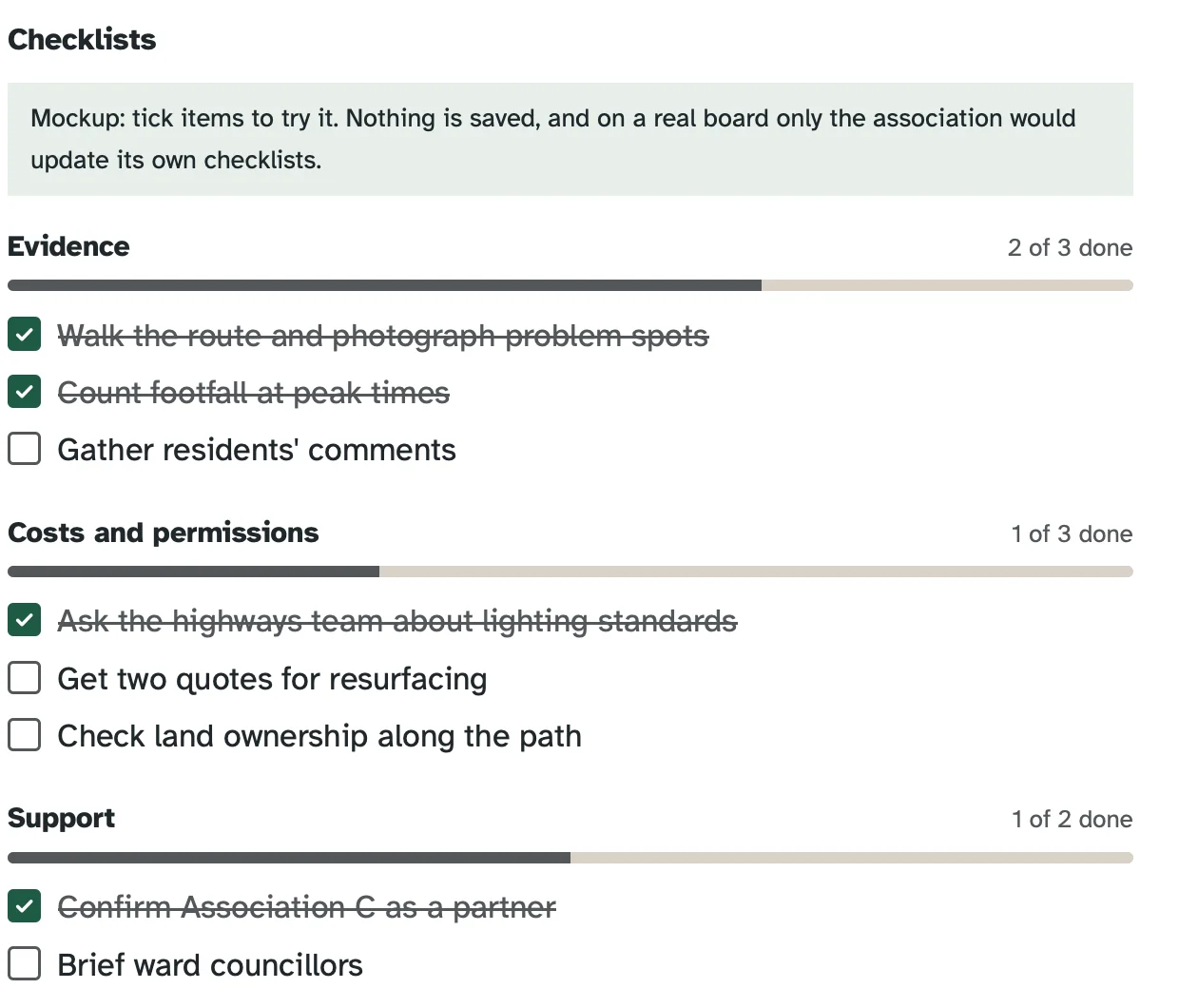
Cards could also hold checklists “much like Trello’s“, so a proposal with several strands of work (gathering evidence, getting costs and permissions, building support) shows at a glance what is left to do. Farnham Voice says the public board should hold “no personal or sensitive information”, with working notes kept separate.
The board online now is a mockup. “The associations, proposals and contacts are examples, not real ones,” the group says on the interactive version.
Who would run it
Farnham Voice recommends a small custom-built website, with each association signing in to change only its own cards, over an off-the-shelf tool such as Trello, which it has used to try the idea out. It says free plans on such platforms have limits, “so as more associations joined, key features could end up behind a paywall.” It adds that the choice would be for the associations.
“This isn’t about creating another committee or hierarchy,” the group said. “Every association would remain independent, and those taking part would decide together how everything operates.”
The proposal rules out “a new hierarchy, an umbrella authority, or a group that decides what other associations can and can’t do,” and recommends a flat structure. It accepts that one association would probably need to champion the effort, a role it says “would be about coordination, not authority.”
“The technology is the easy part,” it says. “The real value comes from associations talking to each other, sharing what they know and helping each other move their proposals forward.”
Where it came from
The group says the idea is months old. In an open invitation dated 6 September 2026, it told residents’ associations it had been “independently gathering and publishing evidence on town-wide issues, including safe crossings, parking zones, and other matters raised by residents,” and asked for a single representative from each association to attend a meeting, “so that every association is equally represented.”
“Residents’ Associations across Farnham work in different ways, and not every part of town has one,” the letter said.
The proposal page lists three associations Farnham Voice has signposted so far: Castle Street Residents Association, North West Farnham Residents’ Association (NWFRA), and South Farnham Residents’ Association (SOFRA). It asks any group missing from the list to get in touch.
The reason for the board, it says, is that “people in Farnham don’t have a clear picture of what’s happening locally, or who’s taking it forward. Finding out shouldn’t mean knowing ten different websites, the right people and their direct contacts, or which councillor to ask.”
What it means for you
Nothing has been decided. Farnham Voice is asking residents’ associations and community groups for feedback, “particularly anyone interested in helping lead and coordinate the effort,” and says: “We’d like the associations themselves to shape what happens next.”
If you belong to a residents’ association or community group, you can read the proposal, try the board mockup and email hello@farnhamvoice.uk with views or to take part.
“Neighbourhood CIL could be the starting point,” the group said, “but the opportunity is to build something that benefits Farnham’s community for years to come.”
For more on how Waverley handles the levy, see our report on the householder CIL review.
Have your say